Creative Boom
The misunderstood, undervalued, forgotten, discarded, and essential value of Silence
02 August
/
3 min.
The Fear of the void
In a society obsessed with attention, silence is treated as an error. Platforms, creators, and brands are terrified of the pause. The mandate is clear: hook them instantly, stimulate them constantly, and never, ever let the user breathe. If there is a gap, fill it. If there is a quiet moment, cover it with noise. Don’t let the user escape.
We have convinced ourselves that silence equals boredom. We are wrong.
The Cost of Clutter
Psychologist John Sweller gave it a name: Cognitive Load. When the brain is bombarded by non-stop stimuli, it doesn't engage more; it shuts down. It’s just a defense mechanism. This is the "Consumer Immune Response." Within 100 milliseconds, the brain identifies cluttered, text-heavy, or "shouting" designs as noise and gates them out.
Crowding your communication isn't a sign of abundance. It is a sign of insecurity. You are screaming because you are afraid no one is listening. Top-tier campaigns use negative space to signal authority. By removing the "commercial clutter," you bypass the brain's filters and allow the visual signal to penetrate deeply.
The Anatomy of a Drop
Think about a song that starts immediately with the chorus. No intro, no build-up, no tension. Just the "loud" part, right in your face. Or a movie that cuts straight to the climax without opening credits, without setting the scene. What would be the point?
You cannot appreciate the "drop" if you haven't felt the climb. You cannot respect the sound if you haven't experienced the silence that precedes it. By removing the void, we destroy the impact of the content. We are not engaging the audience; we are just numbing them.
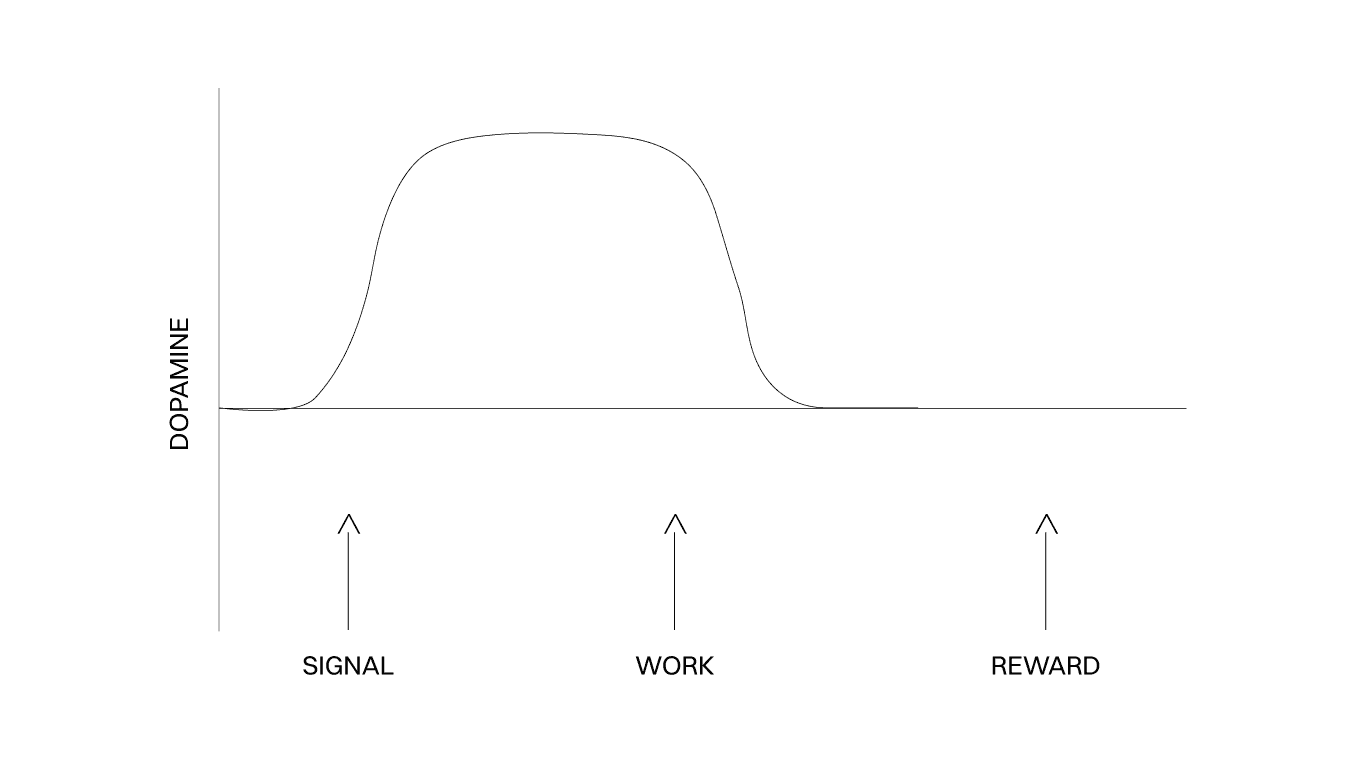
Neuroscience proves that the peak of the human experience resides in the Void of Anticipation. As Robert Sapolsky demonstrated, dopamine levels don't spike when we receive a reward, but during the wait for it. The "Maybe" is more impactful than the "Yes.”
Ma (間)
In Western design, we speak of negative space. In Japanese philosophy, there is Ma (間): the space in-between. It is the gap between pillars that allows a shrine to stand. It is the silence between notes that gives weight to the music.
Ma is "charged emptiness." It is the manifestation of the truth that form and emptiness are one. Without Ma, there is no engagement, only suffocation.
Designing the pause
Silence is not the absence of content. It is a design element. It is the white space in a layout that guides you to look at the subject. It is the pause in a speech that builds anticipation for the next sentence.
We need to stop treating the audience like dopamine addicts who need a fix every half-second. We need to rediscover the courage to make them wait. To let them anticipate. Stop trying to shout over the noise. Sometimes, the most powerful move is to just Enjoy the Silence, as someone from the 90’ said.
promd
Film by PLANE—SITE - Arata Isozaki — TIME SPACE EXISTENCE
Share Article